
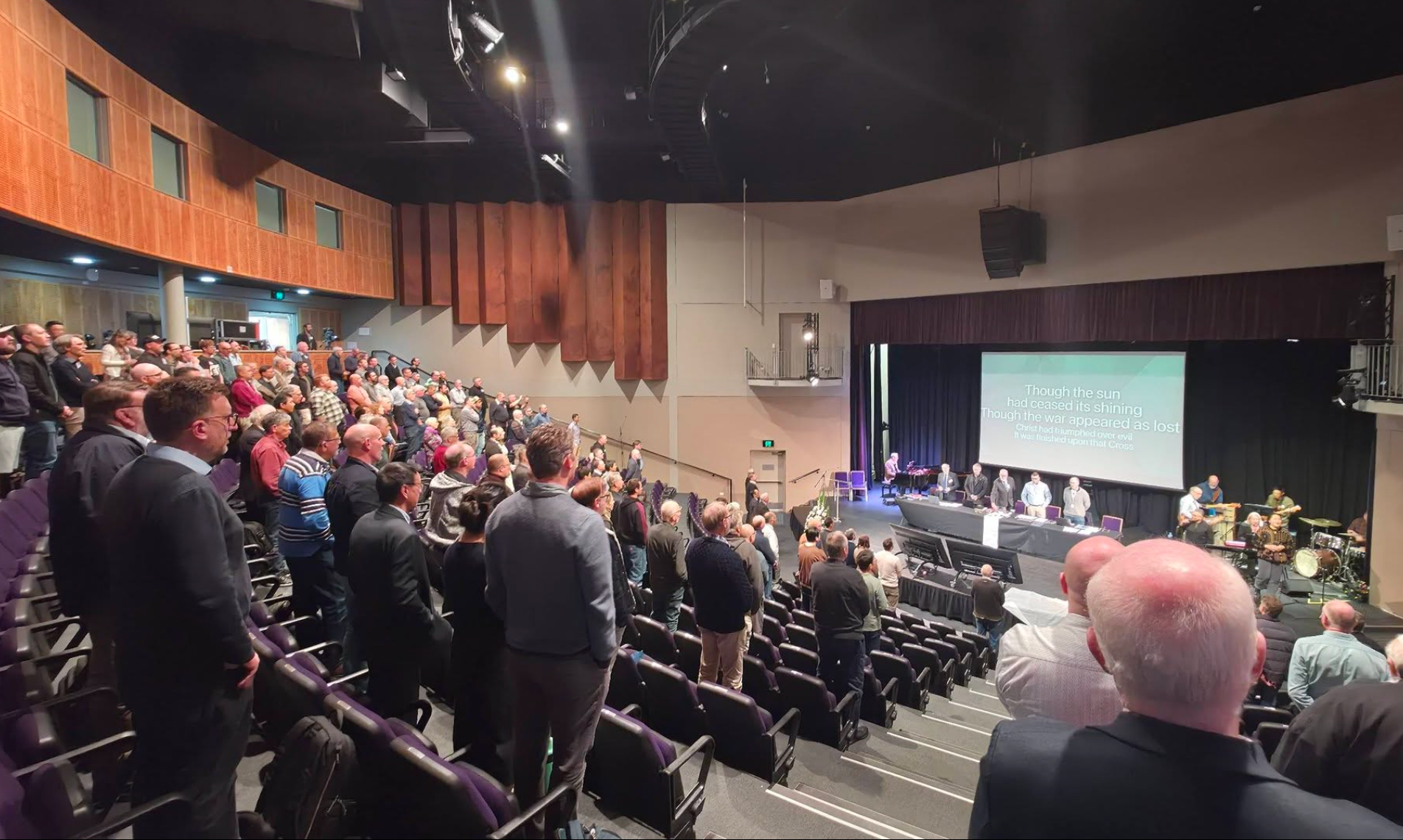
Earlier this week, the General Assembly of NSW met to consider an overture recommending that the qualifications for eldership in The Code be amended to specify that elders be male. The debate on Wednesday was the culmination of a three-year process after discussion in 2023 was paused following concerns that aspects of the debate could breach the NSW Work Health and Safety Act.
I’ve no doubt that a significant number of prayers were offered by many across the PCNSW in the lead-up to this week. I was personally praying that the Holy Spirit would confound us by our love for one another; that we would debate well, speaking the truth in love. I was greatly encouraged to see those prayers answered, as those who engaged in the debate were well thought out, articulate and gracious in their engagement. Our God is faithful.
The Assembly ultimately voted, by a two-thirds majority, to sustain the overture and send it to Presbyteries under the Barrier Act. This means that each Presbytery in NSW will now consider the proposal and report back to the NSW General Assembly in 2027, where their votes will be counted in the Return to Remits.
The debate on the overture regarding eldership reflected a deep commitment across the Assembly to the authority of Scripture, the good of Christ's Church and the faithful proclamation of the gospel. While speakers arrived at different conclusions, there was broad agreement that the question was not about the value of women or the many ways women serve the Church, but about how Scripture should shape the office of elder and how the denomination should respond.
The Case for Male Only Eldership
Those supporting the overture consistently argued that the issue was fundamentally one of obedience to God's Word rather than changing cultural expectations. Several speakers drew parallels with Israel's request for a king in 1 Samuel 8, suggesting that the pressure to align church leadership with contemporary ideas of equality and fairness risked repeating Israel's desire to be "like the nations." They argued that faithfulness is measured not by reflecting culture but by reflecting Christ, asking not what contemporary society expects but what Christ the King has commanded.
Much of the biblical case centred on 1 Timothy 2 and 3. Supporters argued that Paul's teaching reflects a timeless principle grounded in creation rather than a local or cultural circumstance. Complementarianism was presented as God's good design, with men called to spiritual leadership while men and women together share in the mission of the Church. Several speakers argued that Scripture establishes qualified men as elders, not because women are less gifted or valuable, but because the office itself has been entrusted to men.
The nature of eldership itself was another recurring theme. Speakers argued that eldership is more than a functional leadership role; it is an office appointed by Christ through which elders exercise Christ's authority on behalf of his Church. References were made to the Westminster Confession and historic Presbyterian understanding of church government, with the argument that the office represents Christ to his people. Others argued that reducing eldership to a matter of giftedness or organisational effectiveness misunderstood the theological significance of the office.
Supporters also connected church leadership with biblical patterns for households. Drawing on Paul's description of the Church as the household of God, they argued that the structure of Christian families provides a model for church order. Some reflected pastorally on years of ministry, observing both the damage caused by passive or absent male leadership and the blessing that follows when godly men fulfil their responsibilities. They acknowledged failures by church leaders in the past but argued that such failures call men to greater faithfulness rather than changes to God's design.
Several speakers rejected the suggestion that this was merely a secondary issue. While agreeing that salvation through Christ alone is the gospel, they argued that every part of Scripture deserves obedience and that church government is one of the means through which Christ advances his gospel. They warned that if the Church is unwilling to affirm Scripture's teaching on eldership, it risks undermining confidence in Scripture more broadly.
The Case for Male and Female Eldership
Those opposing the overture also grounded their arguments in Scripture but reached different conclusions regarding its application. Several argued that the relevant New Testament passages should be read within their broader biblical context and understood as addressing particular circumstances rather than establishing a universal prohibition. Others argued that Genesis presents men and women sharing responsibility in exercising dominion and that this pattern continues throughout Scripture, including in the shared governance of households.
A number of speakers challenged what they saw as an overly narrow understanding of eldership. They argued that Presbyterian government is characterised by shared authority rather than individual rule and that sessions make better decisions when men and women serve together. Since no single elder possesses authority alone, they contended that women serving alongside men as elders does not contradict biblical teaching on male headship in the family.
Many of the speeches opposing the overture focused on its pastoral consequences. Current women elders spoke personally of being called into eldership rather than seeking it and described decades of faithful ministry. They expressed concern that the overture implied their service had been unbiblical despite bearing fruit in revitalised churches and faithful pastoral care. Others thanked women elders for sustaining congregations, acknowledging that many churches would have struggled without their service.
The likely impact on the wider Church also featured prominently. Speakers raised concerns about women losing voting representation in sessions, presbyteries and the General Assembly, leaving fewer women contributing to the Church's decision-making processes. Others warned of distress among congregations, discouragement among younger women and potential division within local churches. While recognising that thoughtful Christians hold differing convictions, they argued that this was a secondary issue on which the denomination had previously allowed diversity and questioned whether this was a line that needed to be drawn.
One speaker reframed the discussion by arguing that the overture was less about biblical interpretation than about where authority should lie to determine the qualifications of elders. Since elders primarily serve within the local church, he argued that local sessions should retain responsibility rather than the Assembly defining the matter for every congregation.
The Assembly’s Response
In his response, Dr Murray Smith, who moved the overture, acknowledged the grief expressed throughout the debate and thanked women elders for their courage and faithful service under the Church's existing rules. He stressed that the overture made no judgement on the motives or faithfulness of women who had served as elders but sought only to reform the Code for the future. He affirmed the importance of women serving throughout the life and ministry of the Church while maintaining that the biblical office of elder is reserved for qualified men.
Following the debate, a further motion was proposed, "Noting that the eldership debate has caused discomfort for some members:
- give thanks to God for the faithful service of women elders, and acknowledge with gratitude their contribution to the life and ministry of the Church; and
- encourage members to pray for women elders who continue serving faithfully."
These words weren’t just tokenistic.
Moderator Rev Peter Pallett called us to prayer, and for 10 minutes, the Assembly prayed. I watched across the room as up to 300 people gathered together – men and women both sides of the debate crying and praying.
A break for afternoon tea was called, and I remained present with many of the women elders who grieved the impact of the decision. But I was not alone in comforting them. There were chaplains available, but I also observed gracious Commissioners – a handful of elders and ministers, even he who moved the Overture, come and provide comfort. Regardless of their theological position, they did not walk past distress and grief in the room, but instead bore witness and showed the love of Jesus in their care.
The overture now moves to the Presbyteries under the Barrier Act, where it will be considered over the coming year before returning to the General Assembly in 2027.
Over the last 6 months, I have been praying that in this Assembly, we would experience the love of Jesus. I know that there are many still grieving in great distress and pain. I pray that – as we were encouraged in the sermons – they will experience the immense comfort of Jesus, and His sustaining streams of grace.
I left encouraged that, even amid genuine grief, disagreement and deep conviction, I saw brothers and sisters seeking to reflect the love of Christ for one another.
AI-assisted drafting was used in summarising the debate from the author's notes. Experiences and opinions expressed are in the author's own words.